Healthcare Linen Processing Chemistry: What Chemical Suppliers Need to Balance
Healthcare linen processing is not a single cleaning problem. It is a moving target across blood and protein soils, sebum, ointments, food residues, body fluids, barrier creams, hard-water minerals, textile blends, washer-extractor programs, and site-specific disinfection steps.
For an industrial laundry chemical supplier, the commercial challenge is clear: build detergents, boosters, and pre-treatment systems that remove complex soils without creating formulation instability, fabric damage, excessive alkalinity, or unpredictable performance at customer sites.
That is where enzyme selection becomes a formulation decision, not a label claim. The right enzyme package can help improve soil release, brightness retention, low-temperature cleaning, and rewash reduction when it is matched to the detergent architecture and the healthcare wash process.
Enzymimpact supports product managers and technical teams developing differentiated enzyme-based industrial laundry chemistries for healthcare linen processing.
Why healthcare linen is chemically demanding
Healthcare textiles combine high soil variability with strict operational expectations. A plant may process sheets, gowns, towels, pads, privacy curtains, patient wear, and reusable textiles in mixed or segmented workflows. Each category brings different soil loads and different tolerance for aggressive chemistry.
Common formulation pressures include:
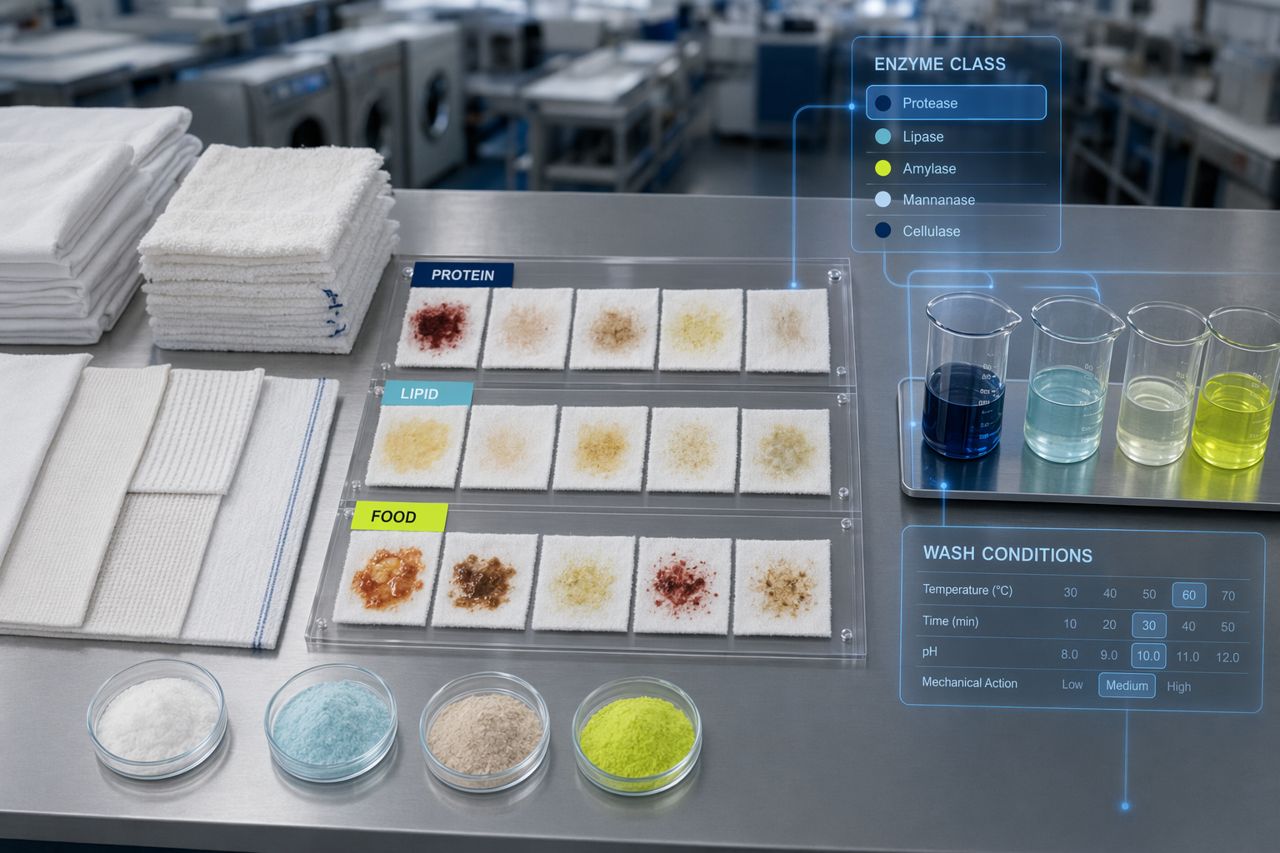
- Proteinaceous soils from blood, perspiration, and body fluids
- Lipid soils from sebum, skin creams, ointments, and emollients
- Starch and food residues from patient meal service
- Pigmented and oxidizable stains that require coordination with bleach systems
- Mixed cotton, polyester, and poly-cotton textile substrates
- Wash programs with variable temperature, alkalinity, mechanical action, and hold time
- Chemical disinfection steps that may be separate from, or integrated into, the cleaning process
- Customer expectations for whiteness, odor control, textile life, and low rewash rates
A healthcare laundry detergent cannot rely on one lever. Surfactants, builders, alkalinity, chelants, oxidants, solvents, polymers, enzymes, and process conditions all have to work as a system.
Enzymes are part of cleaning chemistry, not a substitute for hygiene controls
Enzymes support soil removal. They do not replace validated infection-control procedures, thermal disinfection, chemical disinfection, plant hygiene protocols, or regulatory compliance requirements.
This distinction matters for product positioning. A credible enzyme-based healthcare linen formulation should be framed around cleaning performance: releasing soils, supporting lower-temperature wash strategies, reducing redeposition, and improving consistency across textile categories.
For chemical suppliers, that creates a stronger and more defensible value proposition than overextending hygiene claims.
Enzyme class selection for healthcare linen detergents
Protease for blood and protein soil release
Protease is often the backbone enzyme class for healthcare linen because protein soils are common and can bind strongly to textile fibers. In the right detergent system, protease helps break down proteinaceous residues so surfactants and builders can disperse them more effectively.
Key formulation considerations:
- Compatibility with alkalinity and surfactant package
- Performance under the intended wash temperature profile
- Stability in liquid or powder concentrate formats
- Interaction with oxidants, preservatives, and chelants
- Avoiding premature deactivation in multi-component products
Protease selection should reflect the actual customer wash process, not only a generic stain target.
Lipase for sebum, ointments, and fatty residues
Healthcare linen frequently carries lipid-rich soils from skin contact, creams, massage oils, barrier products, and medical ointments. Lipase can help improve removal of fatty residues that otherwise contribute to dinginess, odor retention, and gradual textile greying.
Formulators should evaluate lipase in the complete detergent matrix because lipid soil removal depends on enzyme contribution, surfactant structure, emulsification behavior, alkalinity, and rinse quality.
Amylase for starch and food residues
In hospital and care settings, patient linens and hospitality textiles may carry starch-based food residues. Amylase can support removal of these residues and reduce the risk of soil fixation during subsequent drying or finishing.
Amylase is especially relevant where healthcare laundries process a broader linen mix that includes food-service-adjacent textiles or patient garments.
Cellulase for controlled fabric appearance benefits
Cellulase can support brightness and surface appearance on cellulosic textiles when used carefully. It may help reduce microfibril-related dullness and support a cleaner fabric surface.
However, cellulase requires cautious selection and positioning for healthcare applications. Product teams need to consider textile composition, fabric-life expectations, dose strategy, and customer process control. It is not a default inclusion for every healthcare linen formula.
Multi-enzyme blends for differentiated detergents and boosters
A multi-enzyme system can be commercially useful when healthcare linen soils are broad and variable. The goal is not to add more enzyme classes for complexity; the goal is to map enzyme classes to the soil profile, wash conditions, and product format.
A practical enzyme package may be designed for:
- Main-wash detergents
- Enzymatic pre-soaks or pre-wash additives
- Low-temperature soil-removal programs
- Detergent boosters for high-soil healthcare routes
- Premium whiteness and rewash-reduction product lines
Balancing enzyme performance with wash conditions
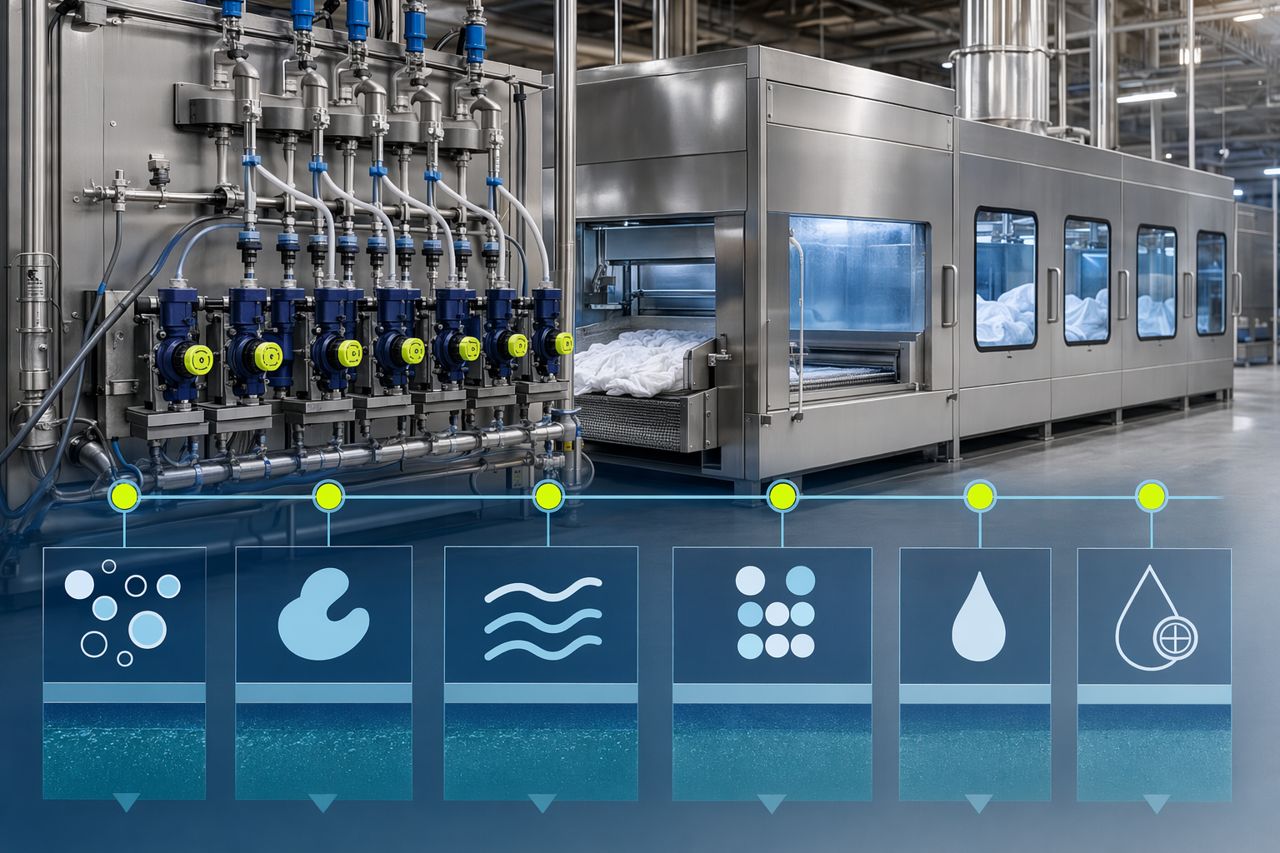
Industrial healthcare laundries operate under real constraints. A formula that performs in a controlled lab screen must remain useful in washer-extractors, tunnel washers, variable water quality, and customer-specific dosing systems.
Important wash-condition variables include:
- Temperature profile and heat ramp timing
- pH at the point of enzyme exposure
- Alkalinity source and builder system
- Water hardness and iron content
- Detergent contact time before bleach exposure
- Soil load variability
- Liquor ratio and mechanical action
- Sequence of detergent, alkali, bleach, sour, and softener steps
For enzyme chemistry, timing is often as important as ingredient choice. If an enzyme is exposed too late, too briefly, or directly into incompatible chemistry, the expected cleaning contribution may not appear at plant scale.
Compatibility with oxidants and disinfection chemistry
Healthcare linen processing commonly uses oxidative chemistry as part of stain removal, whitening, or hygiene programs. Enzymes are sensitive to some oxidative environments, so formulation design and process placement matter.
Chemical suppliers should consider:
- Separating enzyme exposure from harsh bleach exposure where possible
- Designing products for the intended injection sequence
- Using stabilized formats appropriate to the detergent type
- Confirming compatibility with common builder and surfactant systems
- Avoiding assumptions based on household detergent conditions
A strong healthcare laundry product is not simply enzyme plus bleach. It is an engineered sequence where each component performs at the right point in the wash cycle.
Liquid, powder, and additive format decisions
The best enzyme format depends on the supplier’s commercial model and the customer’s dosing infrastructure.
Liquid detergents and boosters
Liquid formats are attractive for automated dosing and operator simplicity. They require careful attention to enzyme stability, water activity, preservative selection, surfactant compatibility, and storage conditions. Product managers should also consider how the enzyme package behaves over shelf life, not only at initial blend.
Powder detergents
Powder products can offer robust handling and flexible builder systems, but particle distribution, moisture control, dust management, and blend uniformity become important. Enzyme granule selection and processing conditions should support consistent product quality through manufacturing, transport, and storage.
Two-part or staged systems
For healthcare laundry customers with demanding chemistry programs, staged systems can be more reliable than forcing every function into one product. An enzymatic pre-wash additive or booster may protect enzyme performance while allowing separate control of bleach, alkali, and disinfection chemistry.
This can create a practical premium product architecture for suppliers serving larger healthcare laundries.
Textile compatibility and fabric-life considerations
Healthcare linen programs are judged not only by stain removal, but by textile replacement cost, whiteness retention, tensile strength, hand feel, odor, and finish quality.
Enzyme-based formulations should be evaluated against fabric-life expectations, especially when working with cotton-rich textiles, reusable gowns, towels, and specialty healthcare articles.
Useful evaluation areas include:
- Visual whiteness and brightness retention
- Soil release after repeated wash cycles
- Fabric strength and surface appearance
- Odor carryover and residue reduction
- Compatibility with finishing chemistries
- Performance on cotton, polyester, and blended fabrics
This is where a formulation-led enzyme supplier can help reduce risk before a product is moved into field trials.
What chemical suppliers should specify before enzyme selection
Before selecting an enzyme or enzyme blend, define the application window. Enzymimpact typically recommends aligning on these inputs early:
- Target product type: detergent, booster, pre-soak, or specialty additive
- Product format: liquid, powder, granule blend, or staged system
- Target textile mix and healthcare linen category
- Dominant soil profile and rewash pain points
- Expected wash temperature and pH window
- Builder, surfactant, chelant, solvent, and oxidant system
- Dosing equipment and injection sequence
- Desired shelf-life profile and storage conditions
- Customer claims and proof requirements
- Scale-up pathway from prototype to production batch
Clear inputs make enzyme class selection faster and reduce reformulation loops.
Commercial value for laundry chemical manufacturers
For an industrial laundry chemical supplier, enzyme chemistry is valuable when it supports a product story that customers can see in plant results.
Potential buyer value includes:
- Better removal of healthcare-specific mixed soils
- Lower rewash pressure on selected linen categories
- Support for lower-temperature cleaning strategies where the process allows
- Improved brightness and reduced grey cast over repeated laundering
- Differentiation beyond commodity alkalinity and surfactant systems
- More flexible product architecture for segmented laundry programs
- Stronger technical confidence during customer trials
The strongest outcomes come from selecting enzymes around the intended process, not simply adding an enzyme blend to an existing formula.
Scale-up confidence: from bench to plant trial
Healthcare linen products need a disciplined development path. Enzymimpact supports enzyme selection with a focus on manufacturability, format compatibility, and practical field use.
A typical development conversation may cover:
- Product objective and customer segment
- Soil profile and textile substrates
- Detergent matrix and wash process conditions
- Enzyme class shortlist and format options
- Stability and compatibility screening in the real formulation base
- Pilot batch handling and storage checks
- Customer trial design and performance comparison
- Final enzyme package refinement for commercial production
This approach helps product managers move from concept to customer-ready chemistry with fewer unknowns.
One-minute explainer: enzyme strategy for healthcare linen chemistry
This page includes a short faceless explainer video summarizing how enzyme class selection, wash timing, and formulation compatibility shape healthcare linen detergent performance.
[Embedded video: Healthcare linen processing chemistry explainer]
Build a healthcare linen enzyme system with Enzymimpact
If you are developing an industrial laundry detergent, booster, or pre-treatment product for healthcare linen processing, Enzymimpact can help align enzyme class selection with your substrate mix, wash conditions, product format, and scale-up requirements.
Use the on-site request a quote form to share your formulation target, product format, and intended application. Enzymimpact will respond with enzyme options suited to your detergent architecture and commercial development path.