Dosing Equipment and Laundry Chemistry: Why Formulation and Pump Setup Must Match
For an industrial laundry chemical supplier, detergent performance is not defined by the formula alone. It is shaped by how that formula is stored, pumped, diluted, sequenced, and delivered into the washer.
This matters especially when enzyme chemistry is part of the product architecture. Proteases, amylases, lipases, cellulases, and blended enzyme systems can help manufacturers build differentiated industrial laundry detergents and additives for protein soils, starch-based stains, fats and oils, fiber care, brightness maintenance, and lower-temperature wash programs. But the commercial result depends on compatibility between the enzyme system, the surrounding chemistry, and the dosing hardware used by the laundry operator.
As an enzyme supplier for industrial laundry chemicals, Enzymimpact supports product managers and formulation teams that need more than ingredient availability. We help connect enzyme class selection with real dosing environments so scale-up decisions are technically grounded and commercially practical.
Why dosing setup changes formulation requirements
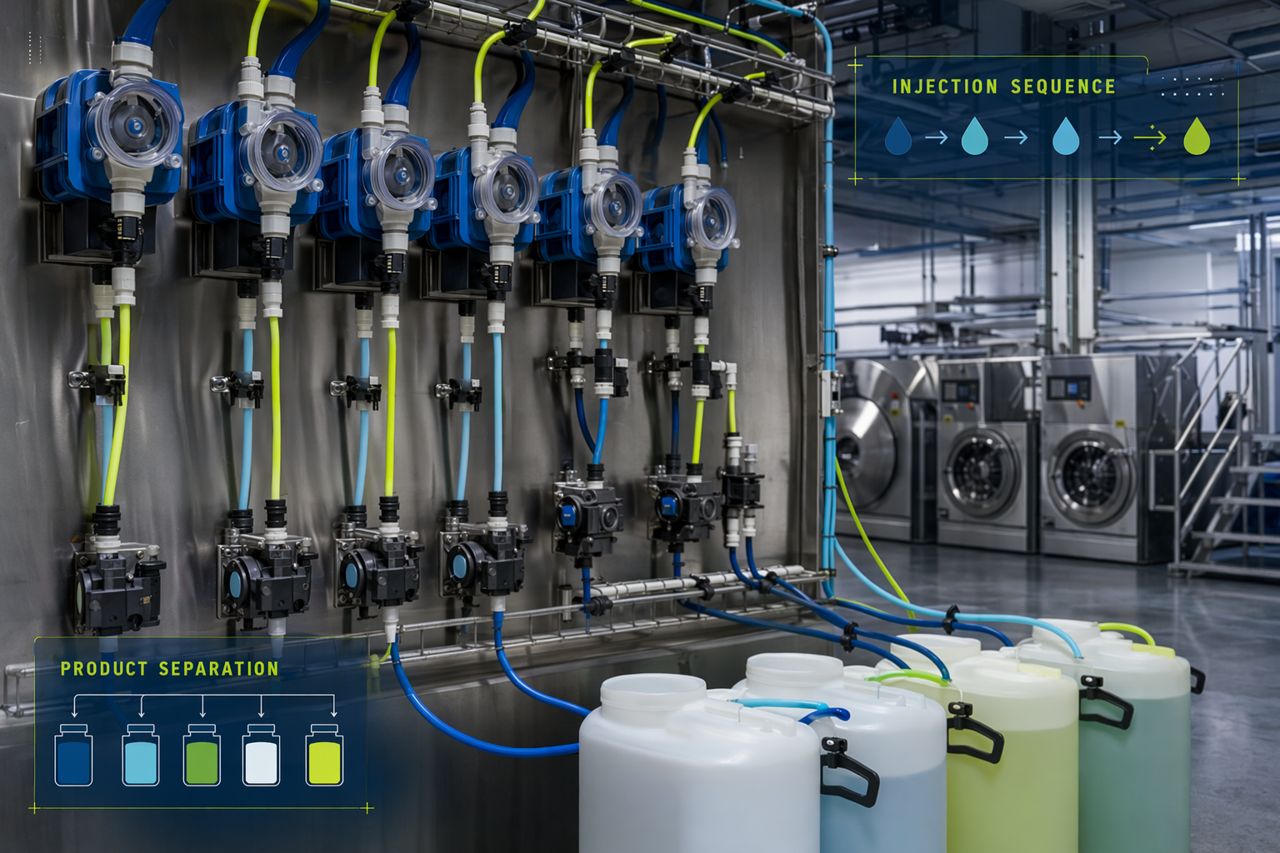
Industrial laundries commonly use automated dosing systems to reduce operator variation, improve chemical control, and support repeatable wash outcomes. These systems may include peristaltic pumps, diaphragm pumps, venturi dilution, multi-product manifolds, day tanks, flush lines, and sequence-controlled injection points.
Each element can affect enzyme-containing products:
- Pump type and shear exposure can influence how liquid detergents, concentrates, and structured additives behave during transfer.
- Dilution ratio and water quality can shift pH, ionic strength, solubility, and ingredient dispersion.
- Line residence time can expose enzyme systems to incompatible chemistry before they reach the wash wheel.
- Injection sequence can determine whether enzymes contact alkali, oxidizers, surfactants, builders, sequestrants, or soil loads under useful conditions.
- Storage temperature and turnover rate can affect product robustness before use.
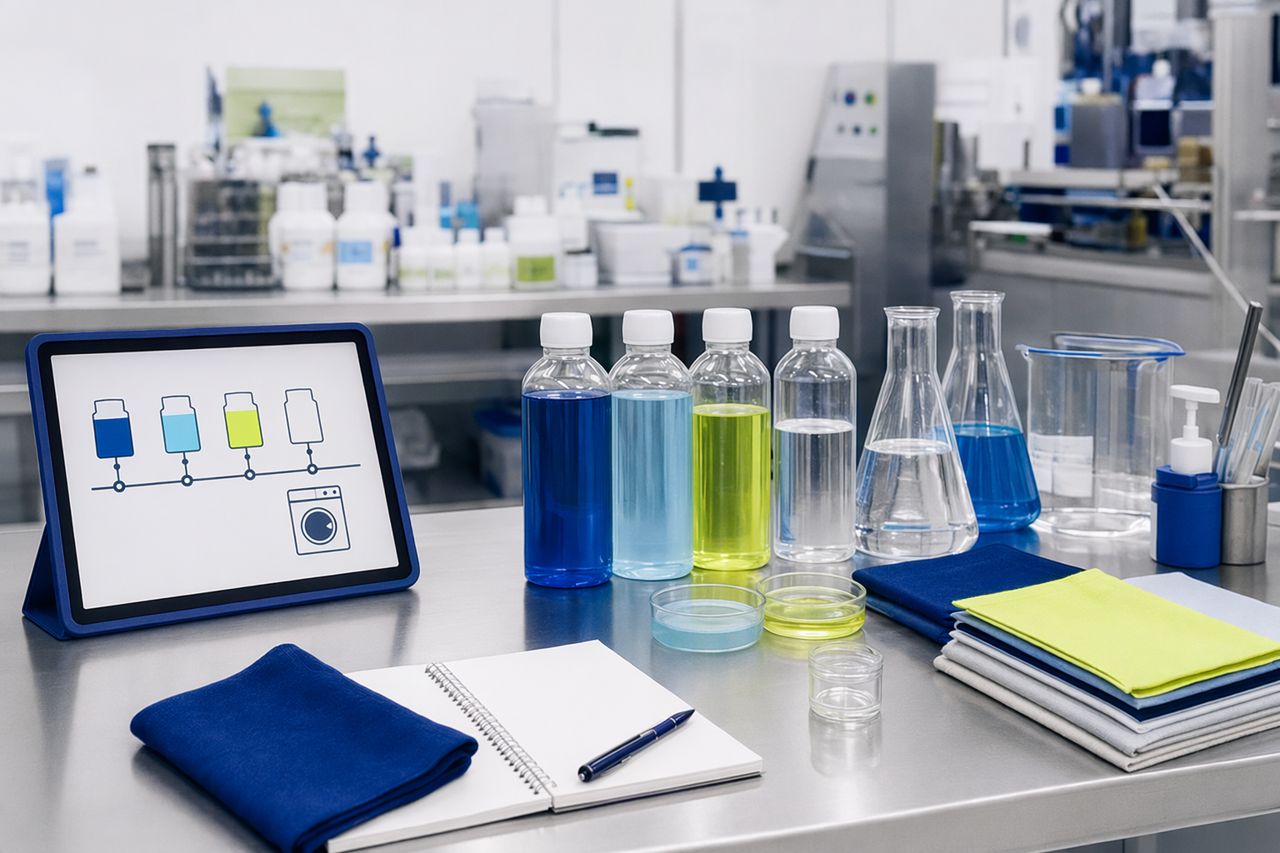
A formula that performs well in a bench wash may underperform in the field if it is dosed into the wrong point, held in a premix too long, or delivered alongside antagonistic chemistry.
The key issue: enzymes need the right chemical window
Enzymes are selected because they are substrate-specific and useful at targeted wash conditions. That specificity is valuable, but it also means the chemistry window matters.
Protease systems
Proteases are typically used for protein-rich soils such as blood, food residues, dairy, egg, and body soils. In industrial laundry formulations, they are often considered for hospitality, food service, healthcare-adjacent, and workwear applications where proteinaceous staining is common.
Formulation and dosing considerations include:
- Compatibility with alkalinity and surfactant package
- Protection from oxidizing components where applicable
- Avoidance of prolonged contact with incompatible concentrates
- Sequence placement that gives the enzyme useful contact time before harsher wash stages
Amylase systems
Amylases target starch-based soils from sauces, gravies, thickeners, and processed foods. For laundry chemical manufacturers serving food service and hospitality laundries, amylase selection can support stain release in wash programs where starch redeposition or incomplete removal affects fabric appearance.
Key considerations include:
- Performance under the intended wash temperature and pH
- Compatibility with builders and water hardness control systems
- Dosing sequence relative to alkaline boosters and main detergent
- Stability in liquid concentrates or additive formats
Lipase systems
Lipases support removal of fats, oils, sebum, and greasy soils. They are relevant for workwear, hospitality, spa, food processing, and kitchen textile programs.
Commercial success depends on:
- The surfactant system’s ability to expose oily soils
- Temperature conditions that support useful activity
- Adequate contact time before high-alkali or oxidizing steps dominate the wash
- Product format decisions that protect enzyme function during storage and dispensing
Cellulase systems
Cellulases can support fabric appearance, surface fiber management, brightness perception, and soil release on cotton-rich textiles when selected and controlled appropriately.
For industrial laundry chemicals, cellulase use requires careful fit with:
- Fabric mix and textile lifetime expectations
- Wash cycle intensity and mechanical action
- pH profile and detergent builder system
- Customer claims and quality-control boundaries
Where pump setup and chemistry often become misaligned
Many field performance issues come from a mismatch between product design and dosing reality. Common examples include:
1. Enzyme product is pulled through a shared manifold
If an enzyme-containing detergent or additive passes through a manifold that also carries oxidizing bleach, high-alkali booster, or other incompatible chemistry, residual contact can reduce performance before the enzyme reaches the wash.
Formulation response: consider product separation, controlled injection sequence, flush validation, or a more robust product format.
2. Concentrate is over-diluted before use
Some dosing systems dilute chemistry before delivery. If the diluted solution sits in a line or day tank, enzyme stability and microbial control become formulation questions, not just equipment questions.
Formulation response: align dilution practice with storage time, preservative strategy, pH, and customer handling instructions.
3. Enzyme is added too late in the cycle
If the enzyme dose enters after temperature, alkalinity, or oxidizer levels have moved outside the intended window, the formula may not provide the designed stain-release benefit.
Formulation response: define the target injection point as part of product specification, not as a field afterthought.
4. Viscosity does not match pump capability
Laundry dosing equipment must deliver consistent volume. Highly viscous concentrates, structured liquids, or products with poor low-temperature flow can produce inconsistent dosing.
Formulation response: balance enzyme stability with pumpable rheology, freeze-thaw expectations, and operator storage conditions.
5. Wash programs vary across customer sites
A chemical supplier may sell one detergent into facilities with different washer types, water hardness, soil loads, temperatures, cycle times, and dosing systems.
Formulation response: build a realistic operating envelope and avoid selecting enzymes only around idealized conditions.
Formulation-led questions to ask before enzyme selection
Before choosing an enzyme class or blend, product managers should define the conditions the product must survive and the conditions where it must work.
Useful questions include:
- What soil categories drive customer complaints or differentiation goals?
- Is the enzyme product a main detergent, booster, presoak, reclaim aid, or specialty additive?
- What pH range will the enzyme experience during storage, dilution, and washing?
- Will the enzyme contact oxidizers, high alkalinity, cationic ingredients, solvents, or concentrated surfactant systems?
- Is the product dosed neat, diluted in-line, held in a day tank, or manually added?
- What pump type, tube material, and line length are common at target customer sites?
- What is the intended injection sequence relative to detergent, alkali, bleach, sour, and softener steps?
- What wash temperatures, contact times, textile types, and soil loads define the target program?
- What shelf-life, shipping, and storage conditions must the commercial product tolerate?
The answers shape enzyme class selection, enzyme blend design, stabilizer strategy, product format, and field instructions.
Product format matters
Industrial laundry chemical suppliers may choose different enzyme delivery formats depending on customer base and dosing infrastructure.
Liquid enzyme detergents
Liquid formats are familiar to automated laundry systems and can fit existing dosing programs. They require careful attention to pH, water content, preservative approach, surfactant compatibility, viscosity, and long-term storage stability.
Enzyme additives
A separate enzyme additive can allow better control over injection timing and chemical exposure. This can be useful when the main detergent requires conditions that are not ideal for enzyme storage or pre-wash activity.
Multi-enzyme blends
Blends can broaden soil coverage, but they also increase compatibility requirements. Protease, amylase, lipase, and cellulase components should be selected with the same wash profile, substrate mix, and formulation constraints in mind.
Concentrates for dilution systems
Concentrates reduce logistics burden, but dosing accuracy, dilution water quality, and line residence time become more important. The concentrate must remain stable before dilution and predictable after dilution.
How Enzymimpact supports laundry chemical manufacturers
Enzymimpact works with industrial laundry chemical suppliers that need enzyme inputs aligned with commercial product development. Our role is to help formulation teams move from target outcome to practical enzyme system selection.
We support discussions around:
- Enzyme class fit for protein, starch, lipid, and fiber-related laundry challenges
- Compatibility with surfactant, builder, sequestrant, solvent, and alkalinity systems
- Liquid detergent, additive, and concentrate format considerations
- Low-temperature wash positioning and energy-saving program support
- Dosing sequence and injection-point implications
- Stability expectations for storage, shipping, and customer-site use
- Scale-up questions before commercial launch
The goal is not to make dosing equipment more complicated. The goal is to design enzyme chemistry that can perform inside the dosing reality your customers already operate.
Practical alignment checklist
Use this checklist when preparing an enzyme-containing laundry product for field evaluation:
- Define the target stain and textile segments.
- Select the enzyme class or blend based on substrate and wash conditions.
- Map the customer dosing system and injection sequence.
- Identify incompatible chemistry and possible line-contact risks.
- Confirm whether the product is dosed neat, diluted, or held before use.
- Tune viscosity and handling properties for pump consistency.
- Set clear use instructions for sequence, temperature range, and product separation.
- Test under conditions that reflect real customer cycles, not only ideal lab washes.
- Build scale-up specifications around stability, packaging, and field dosing behavior.
Build enzyme laundry products around the full system
For industrial laundry chemical manufacturers, enzyme selection should not be isolated from dosing equipment. The same product that looks strong in a controlled wash can lose value if pump setup, dilution practice, or injection sequence works against it.
A formulation-led approach connects the enzyme system, product format, dosing equipment, wash cycle, and commercial claim. That is where more reliable differentiation is built.
Developing an enzyme detergent, booster, or specialty laundry additive? Request a quote through the on-site form and tell Enzymimpact about your target soils, wash conditions, and product format.