How Linen Rental Operators Evaluate Laundry Chemical Suppliers
Linen rental operators do not buy chemistry in isolation. They buy throughput, predictable textile quality, lower rewash exposure, and fewer operational surprises across plants that may process hospitality linen, healthcare textiles, food-service uniforms, wipers, mats, and mixed customer loads in the same week.
For laundry chemical manufacturers, this changes the sales conversation. A detergent, booster, presoak, or specialty additive has to perform inside the operator’s real constraints: water hardness, short cycle time, variable soil load, temperature targets, fabric mix, dosing equipment, and plant-level cost controls.
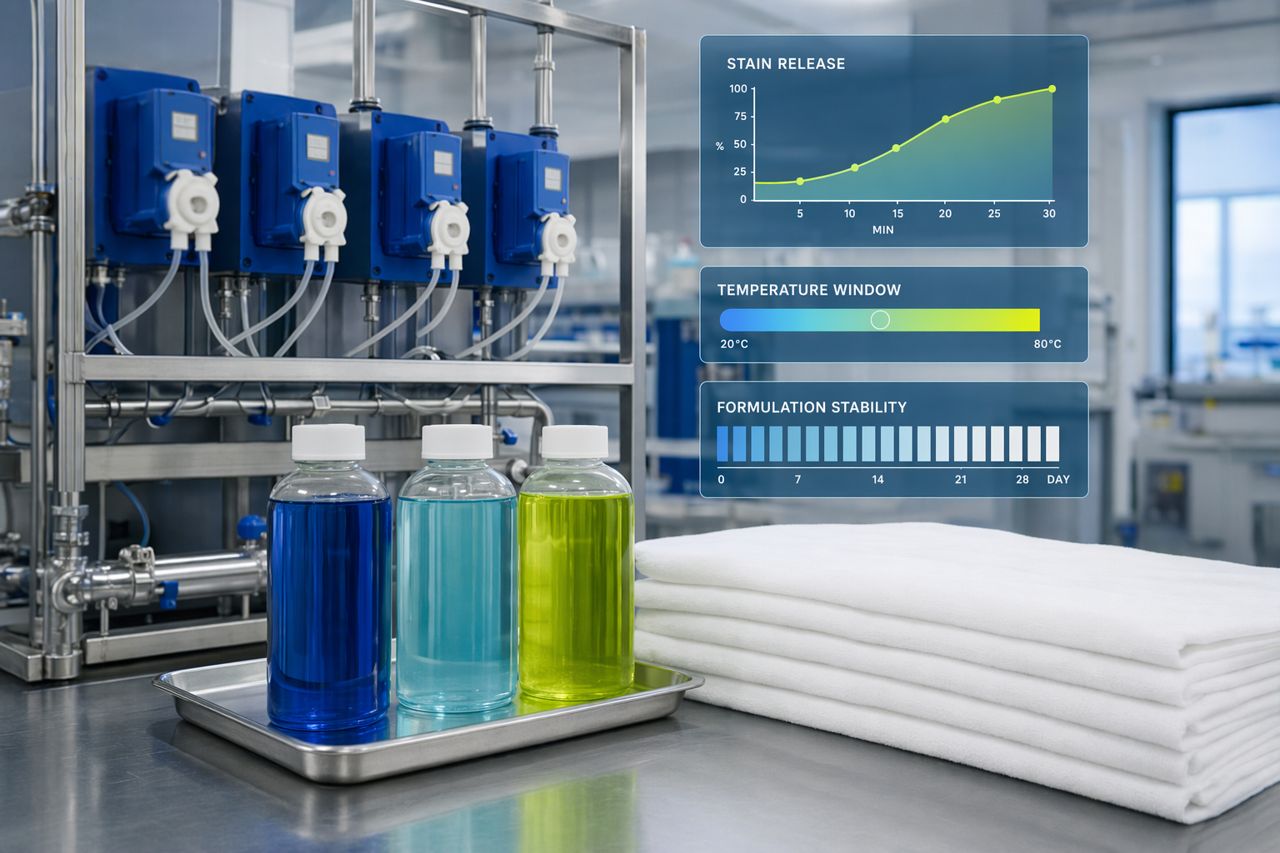
That is why enzyme selection matters. The right enzyme architecture can help a chemical supplier differentiate on stain release, lower-temperature performance, fabric appearance, and wash-program flexibility without forcing the operator into a fragile process window.
The operator’s scorecard: what gets measured
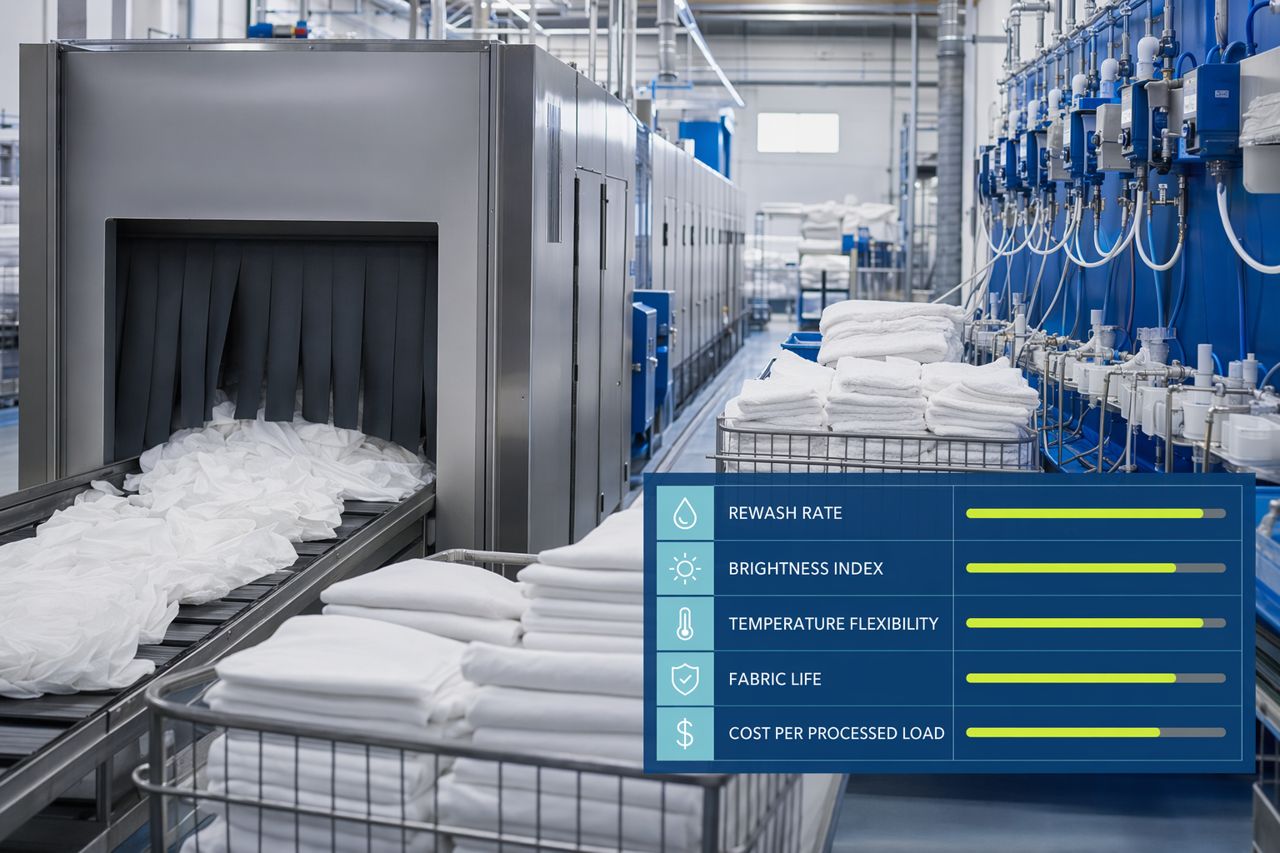
Most linen rental evaluations combine commercial, technical, and service criteria. The weighting varies by segment, but the questions are consistent.
| Evaluation area | What the operator is checking | What it means for chemical suppliers |
|---|---|---|
| Rewash and reject rate | Are stained items returning to production without extra handling? | Build chemistry around visible soil categories, not only generic detergency claims. |
| Cost per processed load | Does the program reduce total wash cost, including utilities and reprocessing? | Position enzymes as part of system economics, not as a standalone ingredient story. |
| Low-temperature wash capability | Can the plant maintain quality while reducing energy demand or protecting fabrics? | Select enzyme classes with useful performance under practical wash temperatures and pH ranges. |
| Fabric brightness and hand feel | Does repeated washing preserve appearance and customer acceptance? | Balance stain removal with fabric care, redeposition control, and compatibility with optical brighteners. |
| Program robustness | Does performance hold across mixed soils, water variability, and dosing variation? | Formulate for stability, compatibility, and forgiving use conditions. |
| Plant implementation | Can the program be installed, trained, monitored, and adjusted without disruption? | Provide clear dosing logic, compatibility guidance, and scale-up support. |
| Supplier continuity | Are raw materials consistent, documented, and commercially available? | De-risk production with reliable enzyme sourcing and technical documentation. |
Rewash is the most visible cost signal
For linen rental operators, rewash is not only a chemistry issue. It consumes labor, water, energy, machine time, and inventory availability. A supplier that can reduce avoidable rewash earns attention quickly.
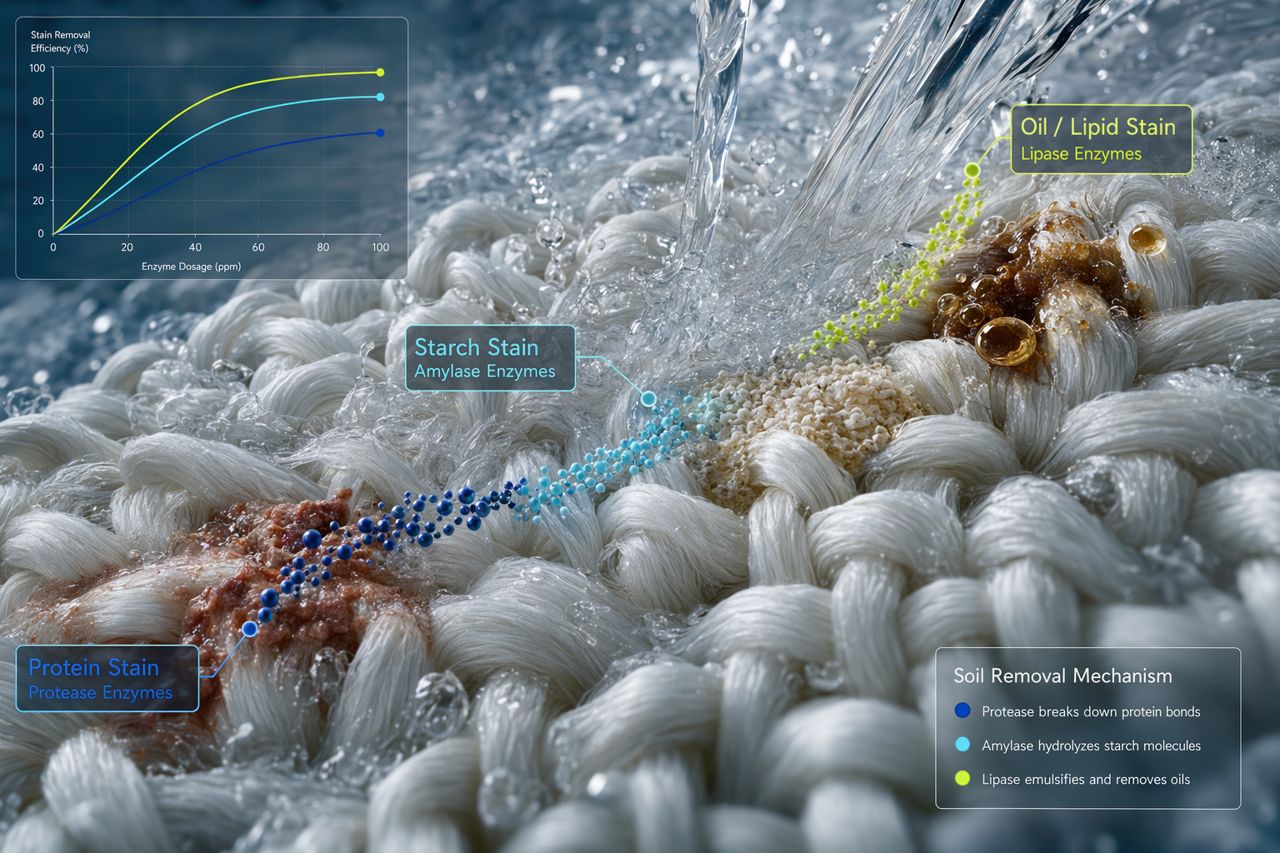
Enzyme-enabled formulations can target common stain families before mechanical action and surfactants do the rest:
- Proteases for protein-rich soils such as food residues, body soils, and certain healthcare-related stains.
- Amylases for starch-based and carbohydrate soils common in hospitality and food-service linen.
- Lipases for fatty and oily residues where emulsification alone may not be enough.
- Cellulases for cotton surface maintenance, brightness support, and reduced fibrillation in selected programs.
- Mannanases and related carbohydrases for thickened food soils, personal-care residues, and polysaccharide-based stains.
The commercial point is simple: operators do not score an enzyme by its label claim. They score the wash program by fewer rejects, cleaner presentation, and less unplanned reprocessing.
Temperature flexibility is becoming a procurement filter
Many operators are under pressure to manage energy consumption while protecting textile life. Lower-temperature and medium-temperature programs can be attractive, but only if quality holds.
For product managers at laundry chemical manufacturers, this creates a formulation challenge: build detergents and additives that remain effective when heat is no longer the main performance lever.
Enzyme class selection can help close that gap. A practical system should be screened for:
- activity under the intended wash temperature range;
- compatibility with alkaline builders and surfactant packages;
- tolerance of water hardness and sequestrant systems;
- performance in short dwell times;
- stability in liquid or powder formats over the intended shelf life;
- fit with oxidizing components, whether separated by product format, dosing sequence, or formulation design.
The best operator-facing claim is not vague sustainability language. It is a documented wash-program outcome: comparable cleanliness at a revised temperature, with defined linen categories and plant conditions.
Fabric life and brightness influence contract retention
Linen rental contracts depend on customer perception. A restaurant notices dull napkins. A hotel notices greyed sheets. A healthcare account notices inconsistent presentation. Even when soil removal is acceptable, fabric appearance can determine whether the chemical supplier keeps the program.
This is where enzyme systems must be designed carefully. Aggressive soil removal is not enough if repeated washing compromises hand feel, shade consistency, or cotton surface quality.
A stronger formulation strategy considers:
- Substrate mix — cotton, polycotton, microfiber, barrier textiles, and specialty fabrics respond differently.
- Soil mix — hospitality, healthcare, food service, and industrial workwear create different stain portfolios.
- Cycle structure — enzyme contact time, pH staging, and main-wash chemistry need to be coordinated.
- After-treatment compatibility — softeners, souring agents, disinfectant steps, and finishing chemistry must not undermine the system.
For linen rental operators, fabric life is a capital issue. For chemical suppliers, it is a differentiation opportunity.
What operators expect from supplier trials
A linen rental operator rarely accepts a new program from a bench result alone. Trials typically move through a staged process:
- Baseline review: current program, water profile, load categories, stain complaints, rewash level, and utility targets.
- Controlled plant trial: side-by-side loads, defined textile categories, operator-observed handling, and consistent dosing.
- Quality checks: stain release, brightness, odor control, hand feel, fabric appearance, and customer-facing acceptability.
- Operational review: dosing reliability, machine compatibility, employee feedback, and troubleshooting speed.
- Commercial review: total cost per processed load, chemical usage, rewash reduction, energy assumptions, and service requirement.
Chemical manufacturers that arrive with enzyme-supported formulation logic, rather than ingredient claims, are easier for operators to evaluate. They can explain what each component is intended to do, where the process window sits, and how the program should be adjusted if plant conditions change.
Building a better supplier answer with enzymes
If your company supplies detergents, boosters, presoaks, or laundry additives to linen rental operators, Enzymimpact can support enzyme selection at the formulation level.
We help product teams think through:
- enzyme class fit by soil target and fabric category;
- liquid and powder format considerations;
- compatibility with surfactants, builders, sequestrants, alkalinity sources, and preservatives;
- wash temperature, pH, and contact-time requirements;
- multi-enzyme blend strategy for broader stain portfolios;
- practical scale-up questions before commercial launch;
- documentation needs for procurement and customer technical reviews.
The goal is not to add complexity. The goal is to build a detergent or additive that answers the operator’s scorecard with cleaner economics and more predictable plant performance.
A practical formulation scorecard for suppliers
Before presenting a new laundry chemical program to a linen rental operator, product managers should be able to answer these questions:
Performance fit
- Which stain categories does the enzyme system target?
- What linen segments are in scope: hospitality, healthcare, food service, workwear, or mixed loads?
- Does the product support lower-temperature, shorter-cycle, or standard-temperature programs?
- What rewash drivers is the formulation designed to reduce?
Compatibility fit
- Is the enzyme stable in the intended product format?
- Are oxidizers, alkalinity, solvents, and preservatives separated or managed appropriately?
- Does the system remain usable across expected water hardness and pH conditions?
- Is the dosing sequence clear for plant implementation?
Commercial fit
- Can the operator connect performance to cost per processed load?
- Can the program reduce avoidable rewash, utility exposure, or fabric replacement pressure?
- Is supply continuity strong enough for multi-site rollout?
- Are technical documents available for internal and customer review?
Scale-up fit
- Has the formulation been reviewed beyond a single laboratory condition?
- Are there known risks in mixing, storage, packaging, or transport?
- Can the enzyme blend be adjusted for regional wash habits or customer segments?
- Is technical support available when the customer moves from trial to contract?
Where Enzymimpact fits
Enzymimpact works with industrial laundry chemical suppliers that need enzyme systems for differentiated commercial products. We support product managers and technical teams developing detergent concentrates, additives, boosters, and specialty wash aids for linen rental and institutional laundry programs.
If you are building a product around stain release, temperature flexibility, fabric appearance, or plant-level robustness, we can help you define the enzyme approach before you commit to scale-up.
Request a quote for enzyme options aligned to your formulation format, target soils, and laundry customer segment.